Product Overview
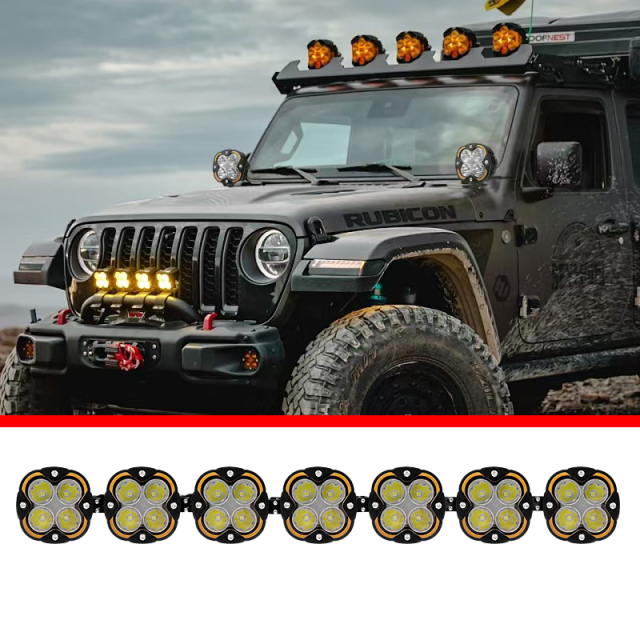
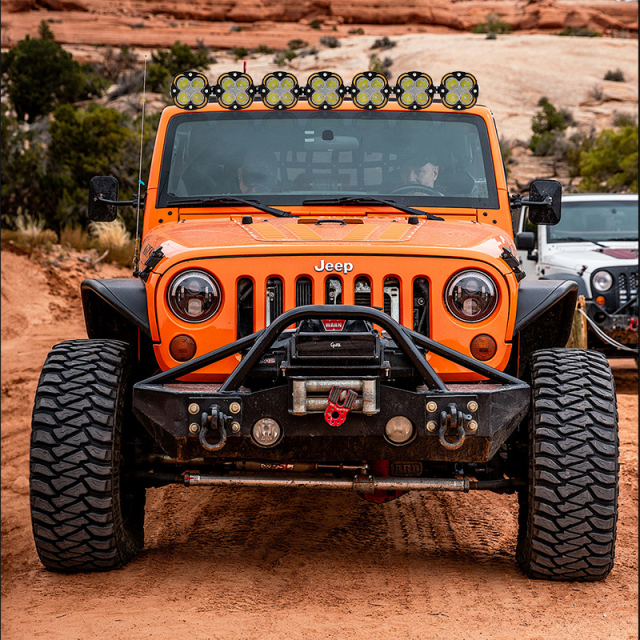
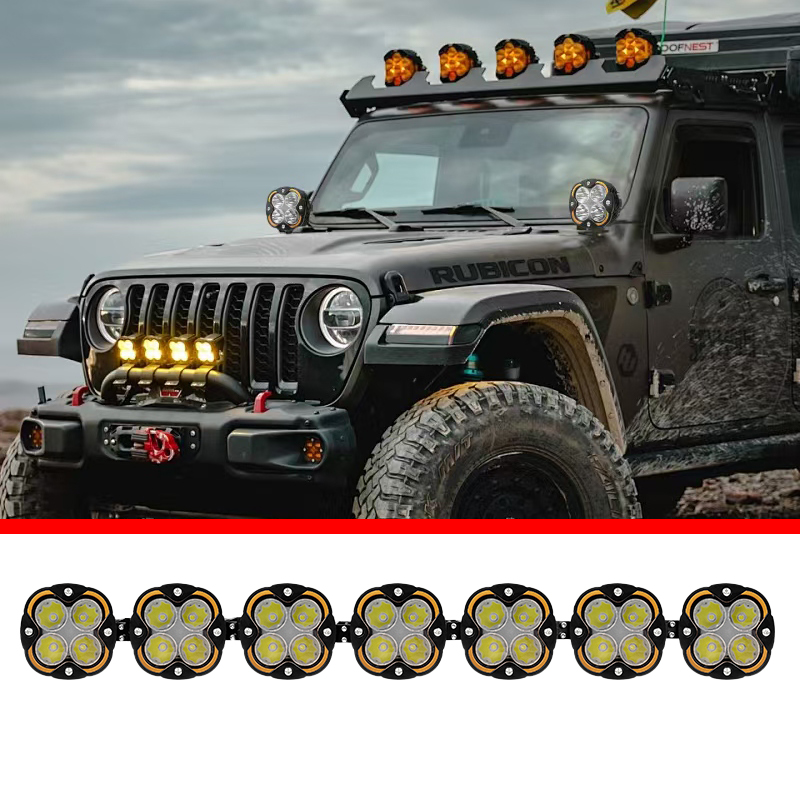
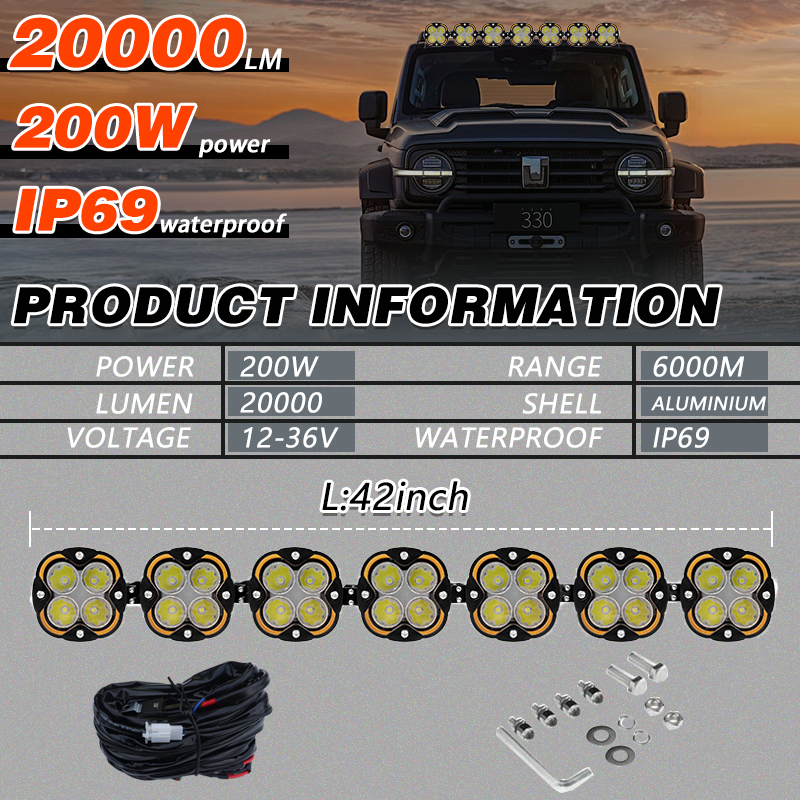
Most auxiliary bars are made in one length and stay that length. This one is assembled from individual 5-inch square LED pods that clamp to each other through a hinge-and-bolt joint, so the same lamp can go out as a short bar for a bumper or a full-width bar across a cab roof, and a single pod can be swapped later without touching the rest of the assembly. For an offroad led light bar that has to sit neatly on a particular rack or cage — or an led light bar for cars that needs a compact fit — it removes the usual compromise between a bar too short for the spread you want and one that overhangs the windscreen. It sells to 4x4 accessory shops, upfit workshops, fleet fitters and web resellers — anyone fitting lighting to more than one vehicle a month — because the length follows the vehicle rather than a catalogue.
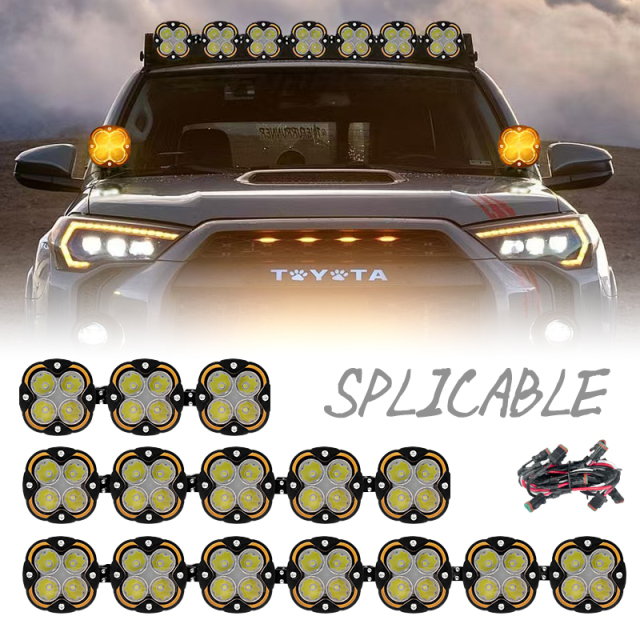
- One bar, several lengths — the pods link through a hinge-and-bolt joint, so the assembly can be supplied at 22, 42 or 52 inches and rebuilt later. For an led light bar for truck roof mounting, the bar can be sized to the rack span instead of overhanging the cab. - Every pod has its own power input — each lamp runs on a separate lead, which means one pod can be isolated for aiming or servicing, or a short section can run on its own as a wide daytime marker. - Beam mix chosen pod by pod — a broad, even spread along the verge plus a tight centre throw for distance is the usual combination, and the pattern can be varied from pod to pod on the same bar. - A platform rather than a single part — the same pods, brackets and fixings go into a utv led light bar build, a pickup bumper bar and a full-width roof bar, so stock, spares and fitting knowledge stay in one place. - Pods are serviceable parts — a cracked lens or a dead lamp becomes a single-pod replacement rather than a whole-bar write-off, which is something most led light bar manufacturers cannot offer on a one-piece sealed bar. - Repeatable from one order to the next — pods, brackets and stainless fixings stay consistent, so a bar fitted this season still matches the next.
Modular Link Design
The joint is the point of the design. Each pod carries a hinge on one face and a matching seat on the other, and a bolt clamps the pair together: slacken it and the pod swings, tighten it and the angle locks. That gives two things a one-piece bar cannot do. The assembly can follow a roofline that curves away at the corners, so the outer pods stay pointed at the road instead of at the sky. And the bar can be broken down — for freight, for storage, or for the day the vehicle is sold and the lighting moves to the next one; take off two pods and a full-width bar becomes a bumper bar. Setup is ordinary workshop work with hand tools, no jig and no press. Where most led light bar manufacturers build a fixed length, we build our light bar supply to the span you send us: tell us the width the bar has to cover, roughly how many pods you want across it, and which pods should throw long and which should spread wide.
Sealing & Hardware
| Ingress protection | IP68K, sealed against water, dust and shock |
| Housing | Aluminium |
| Lens | Clear |
| Fasteners | Stainless steel screws and bolts |
| Pressure management | Pressure equalisation vent |
| Mounting | Brackets for roof rack, bumper and ditch positions |
| Seal layout | Sealed pod by pod, so a 52-inch assembly is protected along its whole length, not only at the end caps |
| Vent duty | Equalises the pressure swing of a hot lamp cooling down after a night run, so moisture is not drawn in past the seals |
| Corrosion resistance | Aluminium body and stainless fixings hold up to road salt, mud and regular washdown |
| Cable entry | Each pod's power lead enters the housing at its own sealed entry point |
| Sealing options | Higher IP69 sealing can be specified on customised orders |
Installation & Wiring
- Mock the bar up in position — roof rack, cab line or bumper — and check that the linked pods clear the roofline, the aerial and the wiper sweep. On a truck led light bar for roof fitment, sit the bar back from the screen so the bonnet does not bounce glare back at the driver.
- Bolt through the brackets with the supplied stainless fixings and tighten evenly, working from the centre outwards so the bar sits square on the vehicle.
- Run each pod lead down to a relay and fuse block, keeping the wiring loom in split conduit and through a grommet wherever it passes bodywork — a sealed connection is what keeps a sealed bar sealed.
- Bring the leads into an offroad light switch panel and group them by zone: front pods, corner pods and any rear-facing pod on separate channels, so the driver can run a wide low setting or the full long-throw setting.
- Aim at night on a flat stretch — centre throw down the road, outer pods wider and slightly lower — then lock the brackets.
- Re-check bolt torque and wiring loom routing after the first rough trip, and again at the first service.
Vehicle Applications
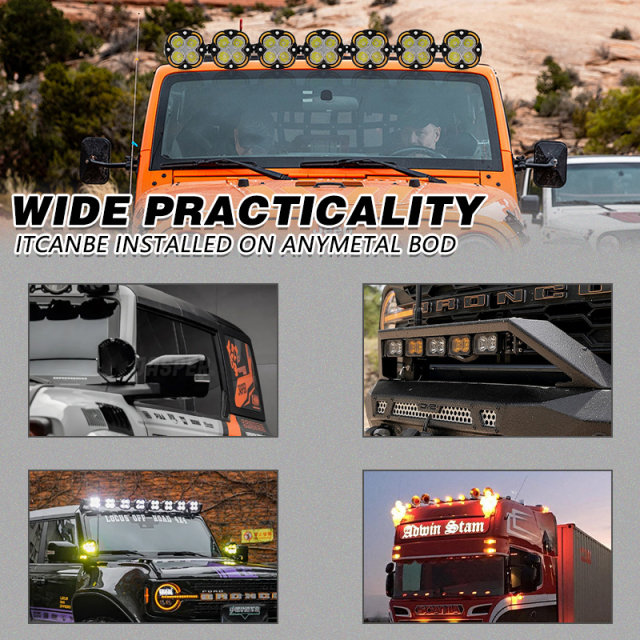
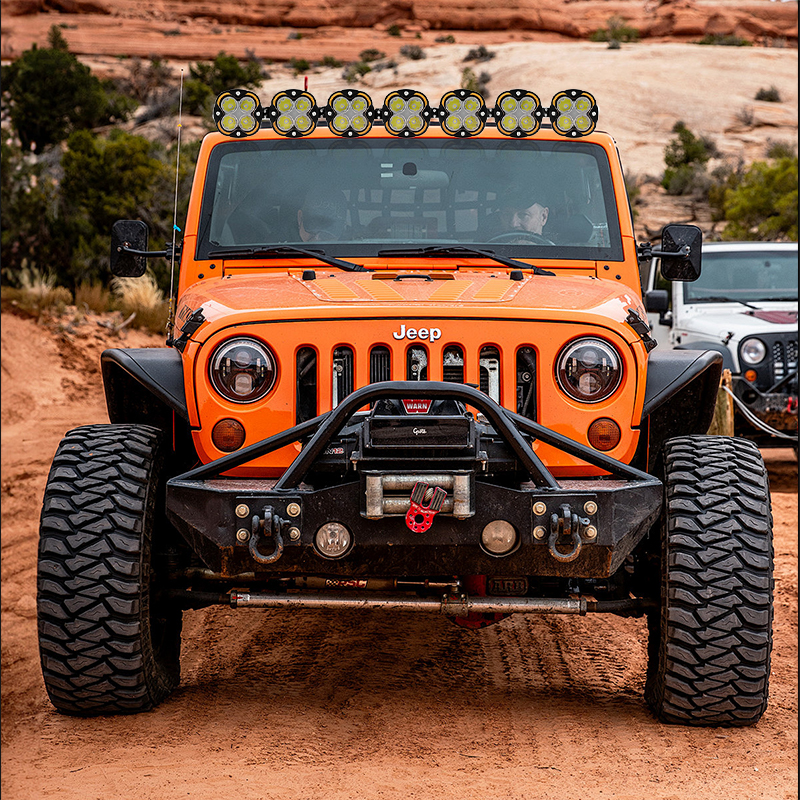
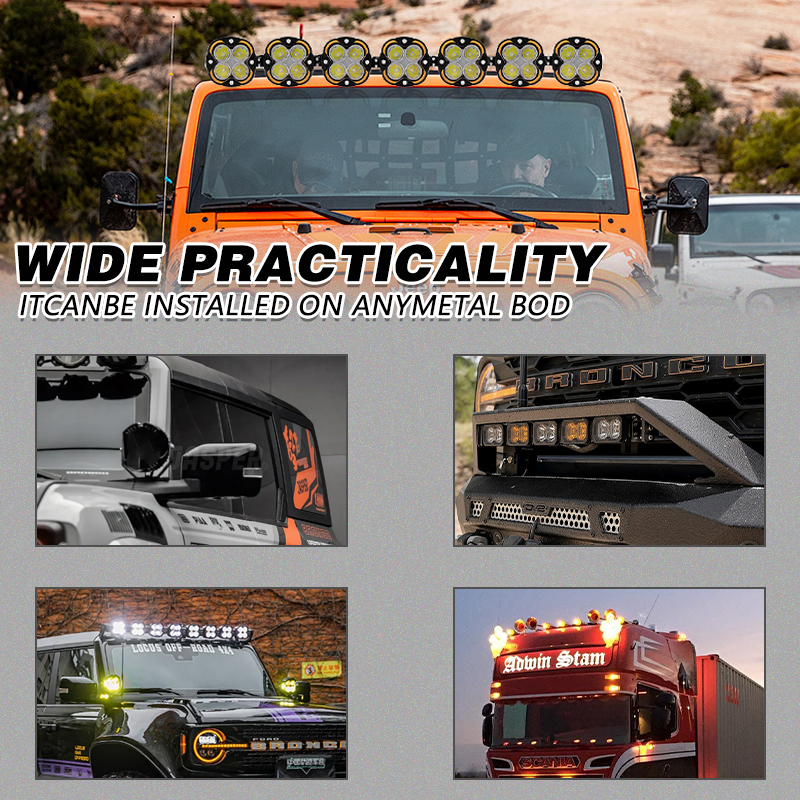
- Trail and rock-crawl rigs — a linked bar across the cage or roof rack puts light on the ledges beside the vehicle as well as the track ahead, and the outer pods can be angled down to pick up the ground close in.
- Side-by-sides and UTVs — for a utv led light bar, a short two- or three-pod assembly keeps the bar inside the cage width, where it survives low branches and roll-over frames better than a full-width bar.
- Pickups and work trucks — a truck led light bar on a bed rack, headache rack or front bumper is where the serviceable pods pay off: a stone-struck lens is a ten-minute swap, not a new bar.
- Forestry, pipeline and survey crews — the offroad led light bar these crews run has to work from first light to the end of a long shift, so sealed housings and stainless fixings matter more than a headline lumen figure.
- Cars, SUVs and daily drivers — an led light bar for cars is normally a light-duty fitment: a short assembly on a lower bumper or behind the grille for unlit back roads, switched off in traffic.
- Recovery and escort vehicles — a bar that splits into zones lets the operator light the winch line, the road behind and the road ahead from one assembly.
- Workshop and reseller stock — one light bar supply of pods, brackets and harnesses covers short and long builds, so the counter is not holding five different sealed bars.
Specifications
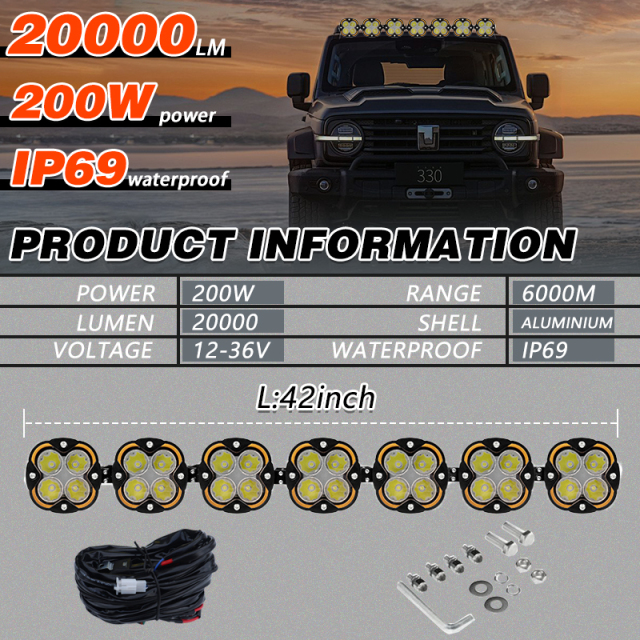
| Product type | Modular LED light bar built from linkable 5-inch square pods |
| Standard bar lengths | 22 in / 42 in / 52 in |
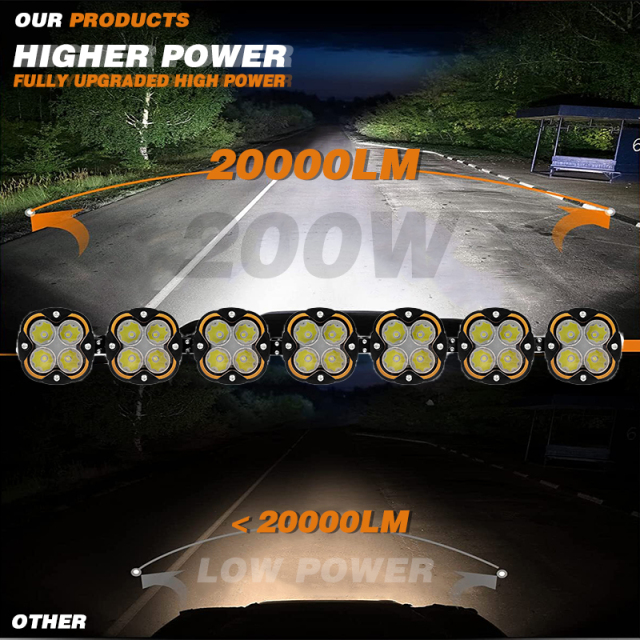
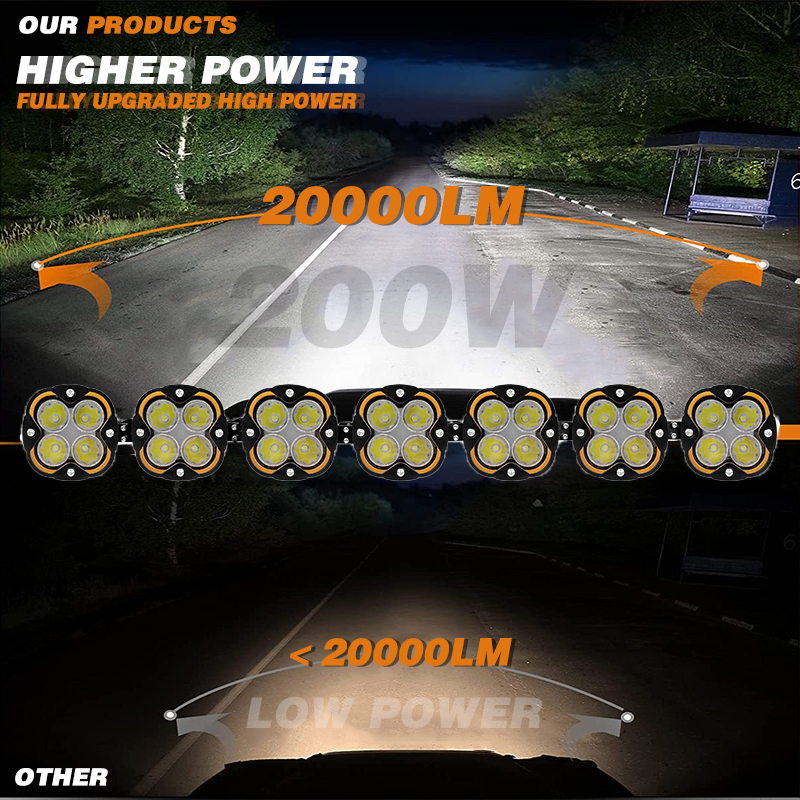
| Power per pod | 200 W |
| Light output per pod | 20,000 lm |
| Colour temperature | 6000 K |
| Beam colour | White as standard, with a yellow beam option |
| Beam character | Wide roadside spread with a concentrated centre throw; patterns can be mixed across pods |
| Control | Independent power input per pod |
Maintenance & Care
The parts that wear are the ones you cannot see. The sealed pods and the aluminium body look after themselves; the hinge joints, the bracket bolts and the pressure vent decide whether the bar still points where you aimed it three winters from now. Treat the joint as a service item — after the first rough trip, and again at every vehicle service, check the hinge bolts along the bar and re-torque them. A joint that has worked loose lets a pod drift out of alignment, and a bar that has crept out of aim is worse than a dim one. Rinse salt and mud off with low pressure, working from the top down, and clean around the vent on the back of each pod with a soft brush rather than a direct jet, because that vent is the one place where the housing is built to breathe. Check the stainless fixings for salt build-up at the same time, and free a stiff thread instead of forcing it. The lens needs nothing more than a soft cloth and mild soap; solvent or an abrasive pad will cloud the polycarbonate long before the LEDs fade, and a lens holed by a stone is a replacement pod, not a repair. Keep one spare pod for each length you stock and note the beam map you fitted, so a swap restores the same pattern instead of changing it. A smear of dielectric grease on the terminals when you reconnect the loom keeps the switch panel channels working through a wet season. If the offroad led light bar comes off the vehicle for a rebuild or a winter lay-up, store it flat and dry, cap the pod leads so the connectors do not take grit, and resist opening a housing that has misted — the vent will clear it, and a housing you have opened will not seal again.
Ordering & Delivery
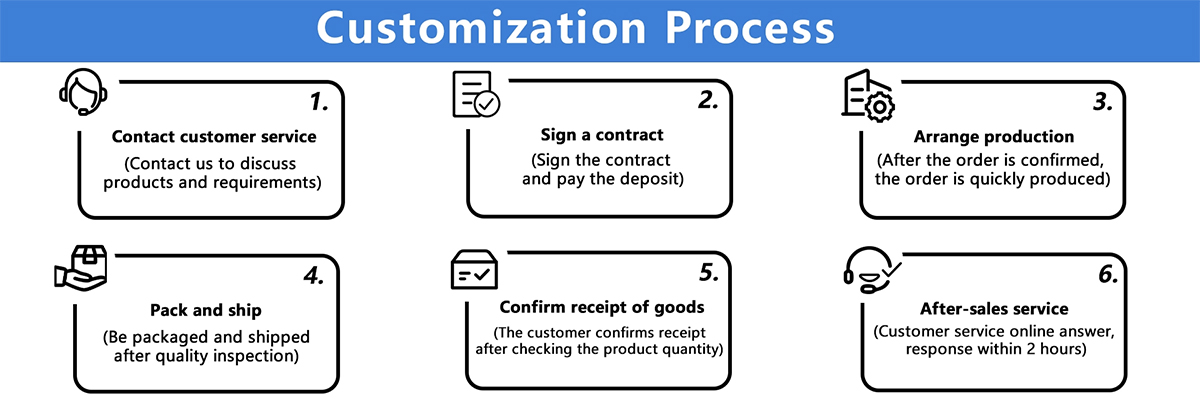
- Tell us the vehicle and the span the bar has to cover — one Jeep, a side-by-side cage, or a season of truck led light bar builds all start from the same measurement.
- Choose the length, the pod count and the beam map. If you are kitting a vehicle out, an offroad light switch panel or other lighting can go on the same order.
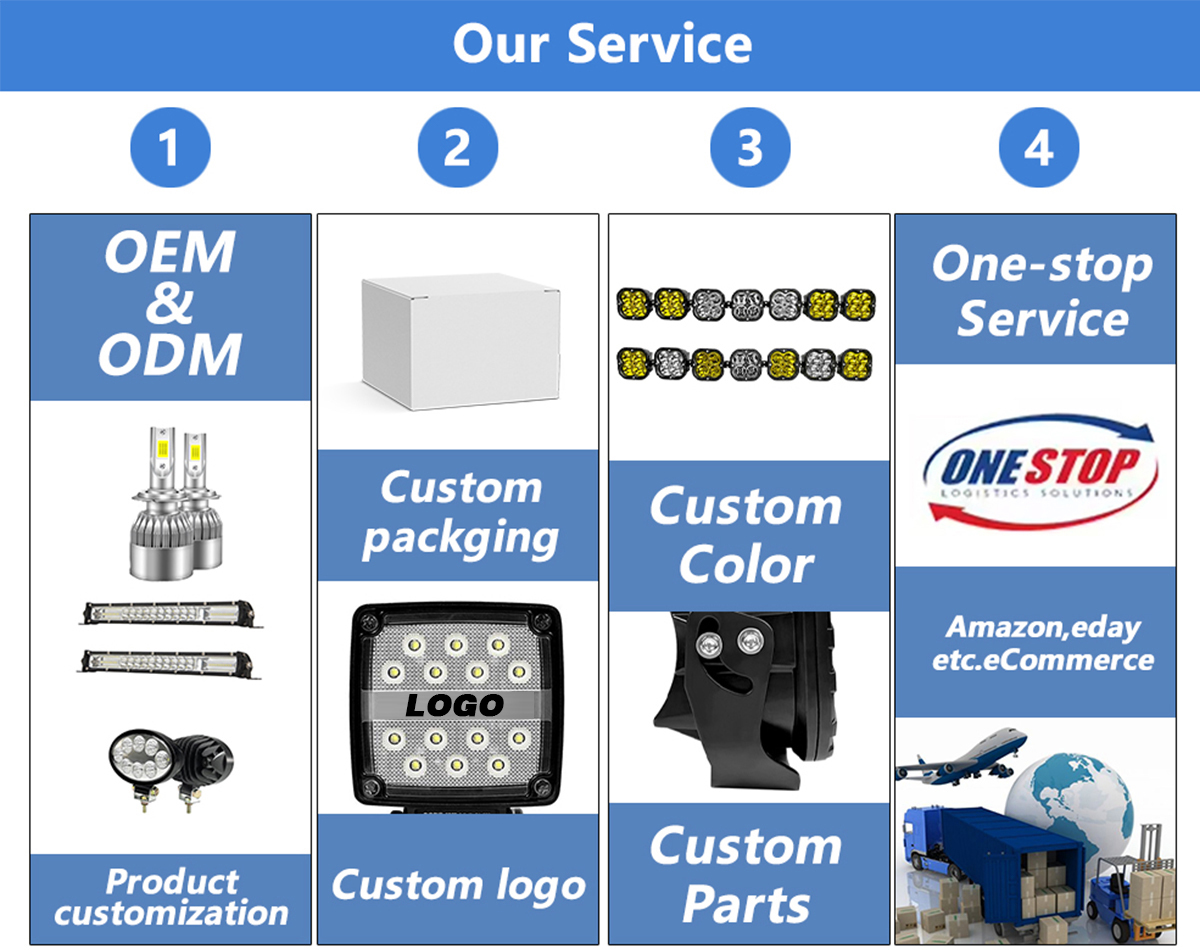
- Confirm branding and packaging — logo, printed sleeve or a specific box layout — if the bar is going out under your own name.
- Settle the commercial side with your sales contact: pricing, minimum order, payment terms, packing and sample availability are confirmed per order rather than published here, and bulk or project planning runs through that same contact.
- As led light bar manufacturers we build the pods here, so a change of pod count, beam map or sealing specification goes straight onto the line instead of back up a supply chain; every assembled bar is checked before it is packed.
- Stock configurations move on our 7-day fast shipping schedule; a custom pod count, beam map or IP68/IP69 build gets its date confirmed when the order is placed.
- The same pods, brackets and fixings stay available across our light bar supply, so a second batch matches the first.
Scale & Supply Capability
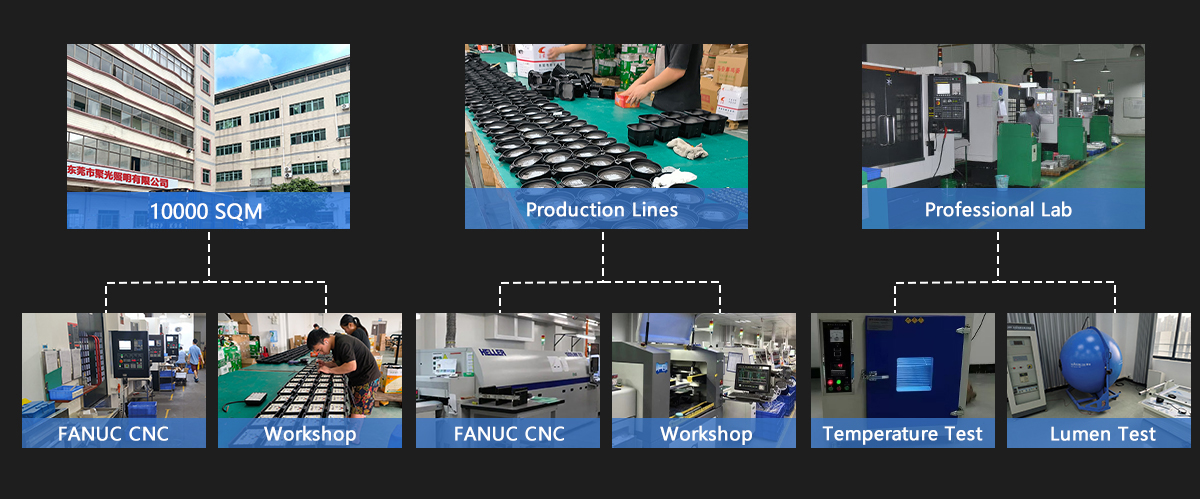
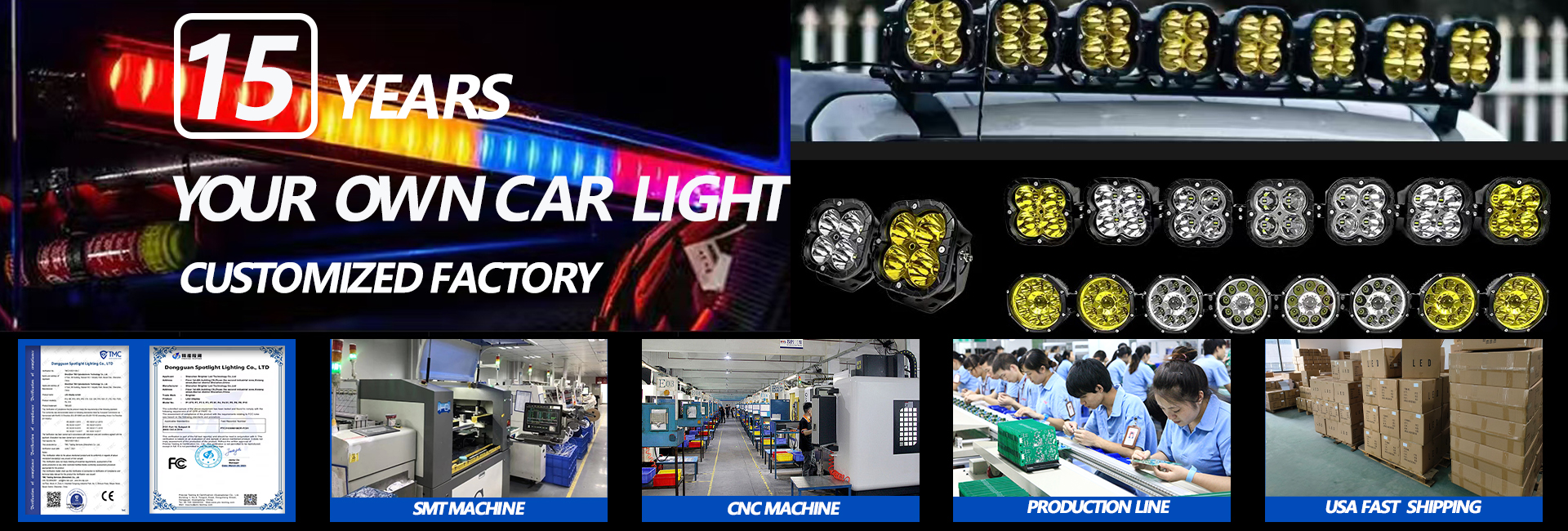
JOPOWER is the brand of our own factory in Dongguan, China, founded in 2010 and run by a team of 20–30 people with 15 years of vehicle lighting production behind them. We add 5–10 new styles every month, hold EU, CE, RoHS and US DOT certification, and put every unit through three full inspections before it leaves us. Because the designs are developed in-house, we can tailor specification, style, size, color, logo and packaging, and items in stock ship in as little as 7 days.
FAQ
What materials and certifications stand behind the durability of this light bar?
The housing is aluminium, the screws and bolts are stainless steel, and the lens sits on an IP68K-rated seal, so water, dust and vibration are dealt with at the housing rather than left to the wiring. The offroad led light bar is built to CE, RoHS and DOT standards, and the compliance documents your own customers or a fleet file will ask for can go out with the shipment — request them when you place the order so they travel together.
Can the length and pod layout be changed to suit a particular vehicle?
Yes. The bar is built from linked 5-inch pods, so it can be supplied at 22, 42 or 52 inches as standard and assembled to a different combination when a vehicle needs something in between — a short bar tucked behind a grille, or a wide one for an led light bar for truck roof mounting. Send the span you need to cover and the beam map you want, and we confirm the pod count and joint angles before production.
Is professional installation required, and can each pod be switched separately?
The mechanical side is straightforward — the brackets bolt through with the supplied stainless hardware — but the wiring is where a professional earns their fee, particularly on a vehicle with a CAN-bus electrical system. Whether it is a pickup or a utv led light bar build, the principle is the same: every pod has its own power input, so an offroad light switch panel can drive the bar in zones, with front pods, corner pods and any rear pod on separate channels. Have the installer confirm the take-off point and fuse rating for your vehicle before anything is cut.
Is the beam white only, or can I order yellow?
White at 6000 K is the standard build, and a yellow beam option is available for dust, fog and falling snow, where a warmer light cuts glare instead of bouncing it back at the driver. Buyers running an led light bar for cars on winter roads often ask for a mixed bar — white pods through the centre, yellow at the ends. Tell us the mix you want pod by pod and it is built that way.
When should I choose the IP68 or IP69 option instead of the standard IP68K build?
The standard IP68K build handles rain, dust, mud spray and the vibration of washboard tracks. If the vehicle is washed down with a high-pressure lance at close range, or works in repeated deep water, specify the IP68 or IP69 configuration when the order is placed — that sealing is built to order, so it has to be in the specification before production starts rather than added afterwards.
How do I keep the lens and housing in good condition?
Rinse mud and salt off with low pressure rather than a hard jet, and avoid pointing a pressure washer straight at the pressure-equalisation vent on the back of the pods. Wipe the lens with a soft cloth and mild soap, since solvents and abrasive pads cloud it. After a rough trip, check the bracket bolts and the wiring grommets, and re-aim the bar if a pod has taken a knock.